
Turning YouTube audience signals into creative decisions.
YouTube is the largest kids’ media ecosystem in the world. Billions of views, hundreds of thousands of videos, across dozens of languages. Yet most creative decisions in kids’ content are still driven by instinct.
Not because teams don’t value data, but because the right data doesn’t exist in a usable way.
Strict privacy regulations like COPPA and GDPR-K limit behavioral tracking. What’s left is surface-level: views, titles, publish dates. Nothing about what’s actually inside the videos, and why some perform while others don’t.
In a market this competitive, that’s a blind spot.
We built the Audience Intelligence Tool™ to fix it.
From Guesswork to Understanding
When our creative teams sit down to develop the next seasons of our shows, or a new episode, or explore a new IP concept, the questions are simple, but traditionally hard to answer:
- Where is the real opportunity vs saturation?
- What visual styles perform best for preschoolers versus early elementary?
- What do top-performing videos actually do differently in characters, music, pacing, storytelling?
Instead of analyzing audience behavior, we analyze the content itself: what top-performing videos look like, sound like, and how they differ from underperformers.
This is contextual intelligence: understanding performance through creative signals.
How the Audience Intelligence Tool™ Works
The system analyzes 1.5 million videos, and continues to grow every week, across multiple dimensions: visuals, audio, characters, narrative structure, pacing, editing, and music.
Each video goes through two AI steps:
- Observation: a model watches the video and writes a detailed description of what it sees and hears, with no predefined categories or labels. This matters because predefined categories limit what you can discover. By observing first, the system captures both expected and unexpected signals.
- Classification: that description is structured across 50+ creative attributes. Because the observation is already complete, we can extract any dimension we need from it — now or in the future — without re-processing a single video. New question? New attribute? We just add a classification layer on top of the same observations.
Alongside this, the system extracts measurable signals: edit rhythm, voice-to-music ratio, color, brightness, face presence, and text overlays.
The result: a searchable map of the ecosystem, based on what content is, not just how it performs.
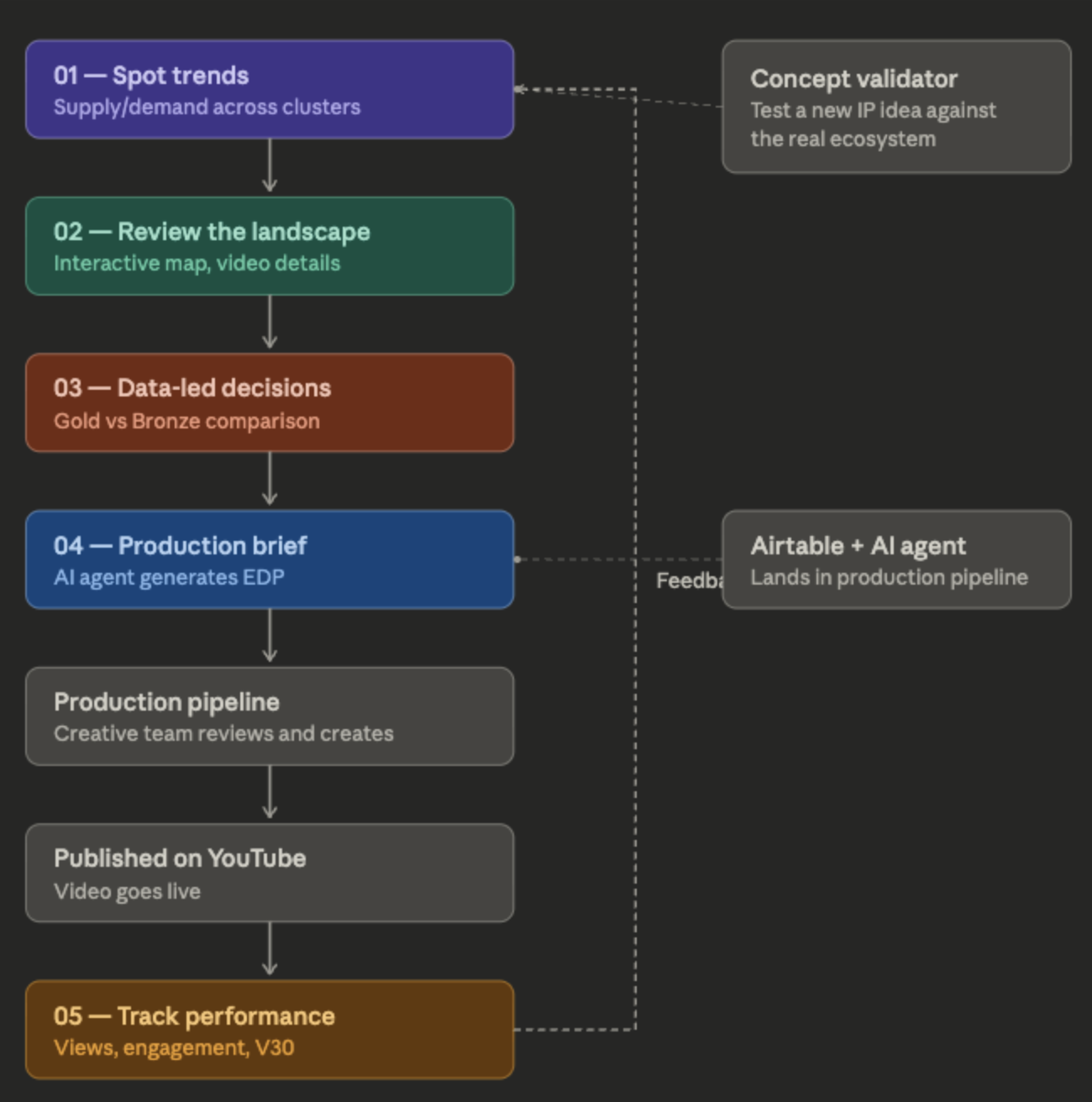
From Data to Decisions: A 5-step Workflow
The tool mirrors how our creative teams actually work. To make this concrete, we'll walk through how we used it to develop Season 3 of Kidibli and how it led to a 3x performance increase over Seasons 1 and 2.
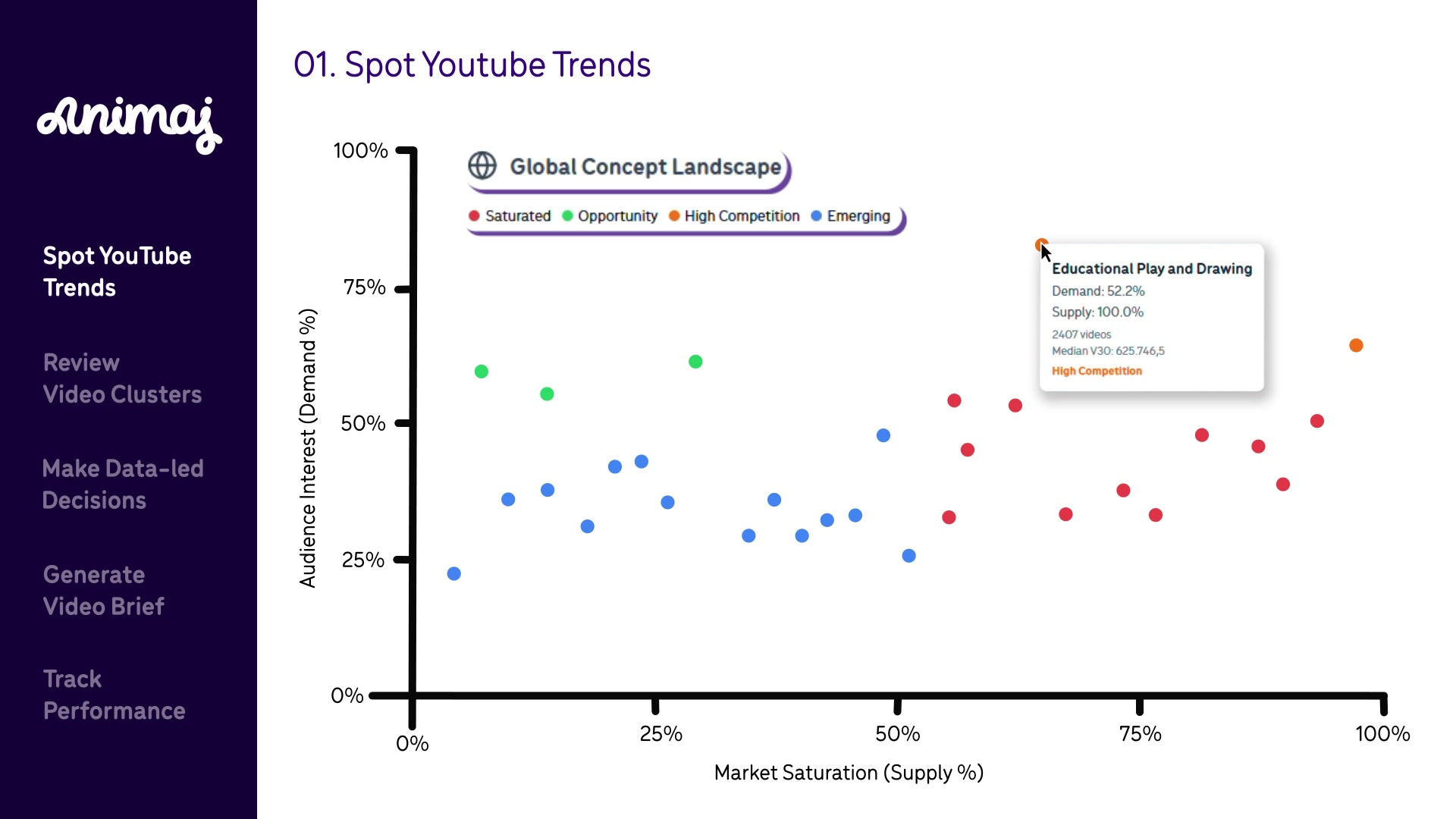
01 — Spot trends
A supply-and-demand view highlights where to play and what to avoid.
For Kidibli S3, this is where we identified that toy play, a vertical that has historically been one of the most challenging to crack on YouTube Kids. It still had pockets of high audience demand with relatively low video quality supply.
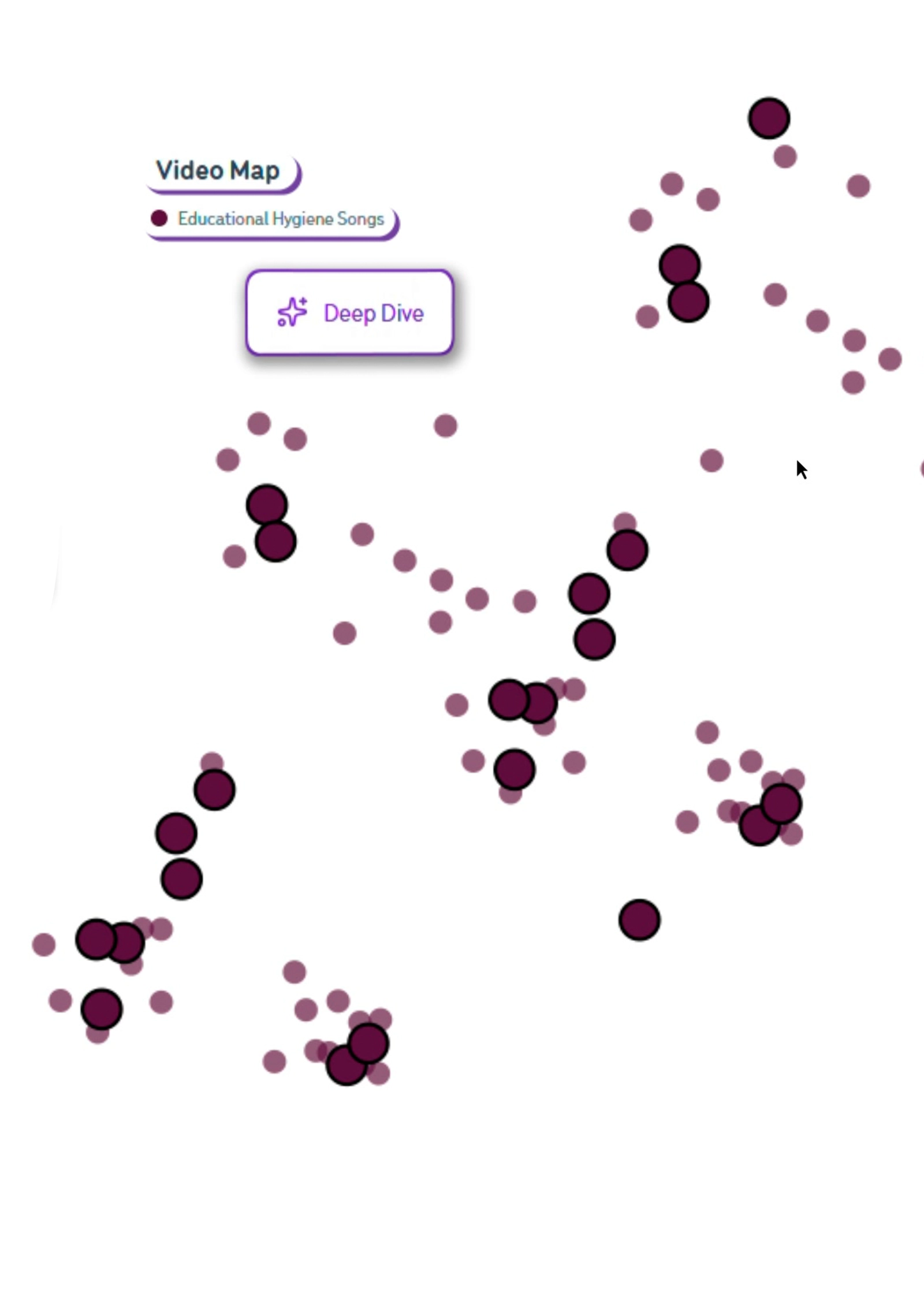
02 — Review the landscape
An interactive map groups thousands of videos by similarity. Our teams explore clusters, watch references, and understand what a space actually looks like.
For Kidibli, our teams spent time inside the toy vehicle cluster studying what the top performers had in common: relatable physical toys, simple rescue narratives, high-energy pacing, and minimal character complexity — just hands, toys, and action.
03 — Make data-led decisions
Top vs bottom performers within any filtered group are compared to isolate what drives success across character design, audio, pacing, and narrative.
The Gold vs Bronze comparison for the toy play cluster gave us a precise creative direction: keep it physical (real toys, not animation), build around a clear rescue with problem-solution arcs, front-load the action, and let the vehicles be the stars.
04 — Generate a production brief
Insights are turned into a complete Editorial Development Plan (EDP): creative direction, references, and data-backed rationale, all ready for production.
The brief goes to the creative team, who reviews, refines, and produces the video. Then it's published on YouTube, and the cycle continues.
05 — Track performance
Once live, performance feeds back into the system. The loop continuously improves.
The result? One of the Kidibli S3 episodes — a toy vehicle rescue video where a tow truck and police car team up to save a sports car, has reached 37 million views. Toy play, the vertical we struggled with most in earlier seasons, became our breakout format. Season 3 overall performed 3x better than Seasons 1 and 2, driven by creative decisions that came directly out of the tool.
See it in Action
A short walkthrough shows how the tool works in practice, from identifying a high-potential cluster, to deep-diving into patterns, generating a brief, and tracking performance.
Testing Ideas Before Production
One feature our teams use constantly: you can describe a new concept/idea in plain language —
a friendly dinosaur teaching colors through songs — and instantly:
- find similar content
- position the idea in the market considering the supply and demand on YouTube for this concept
- identify competitors
- evaluate opportunity
Concepts are stress-tested before production begins.
Designed to Support Creative Teams
Three principles define the system:
Observation first. We describe before classifying, ensuring richer, more reliable data.
Transparent, not prescriptive. Every insight is backed by evidence and real examples. The tool informs, it doesn’t decide.
Privacy-first by design. No behavioral tracking. No personal data. Only content signals.
Why it Matters
Digital-first production requires speed — but also precision. The Audience Intelligence Tool™ allows us to:
- reduce creative risk
- identify opportunities earlier
- align creative direction with real audience signals
- move from intuition to informed decisions
It’s not about replacing creativity. It’s about giving it a stronger foundation.
What's Next
The tool is already embedded in our production pipeline. We’re expanding:
- the volume of analyzed content
- music and audio intelligence
- and new applications, including contextual, brand-safe advertising
Our goal is simple:
build better content for kids — by understanding what truly resonates.

.svg)